OOPS: Overvoltage Overcurrent Protection System
May 2026
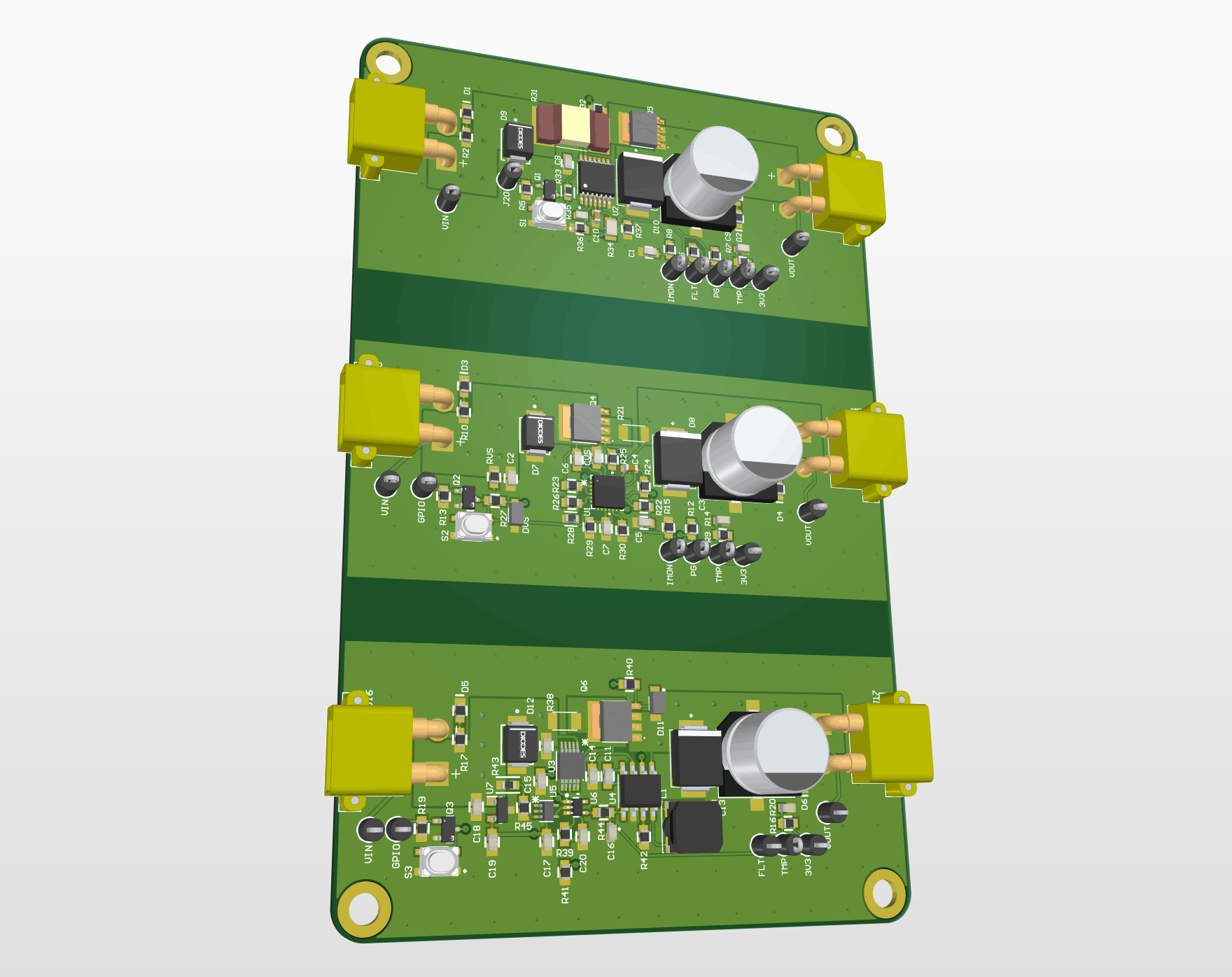
On a shared low-voltage rail, one shorted board can take the entire bus down with it if protection lives centrally. Distributing protection per-board solves that, but doing it with discrete analog parts instead of a single hot-swap IC means designing the latch, the disconnect, and the blanking logic by hand for every node on the car. OOPS is that discrete circuit, deployed across roughly 10 boards on Berkeley FSAE's 24V/400W low-voltage rail. The signal chain pairs an INA241 current-sense amplifier with an LM2903-Q1 comparator for fast OC detection, then hands off to a TLV9022L-Q1 wired as a latching SR element that holds the fault state until manually reset. Trip signals from any monitor wire-OR onto the IN pin of an IRS10752PbF gate driver through open-drain outputs, which then turns off a BUK7Y3R1-80MX low-side MOSFET to disconnect the load. RC blanking on each comparator absorbs inrush transients while keeping sub-microsecond response on real faults. Alongside the discrete circuit, I designed an evaluation PCB in Altium with hierarchical sheets that benchmarks three protection approaches side by side: the LM5069 hot-swap controller, the LM74930-Q1 ideal-diode, and the discrete latching topology above. Each board on the car now carries its own latching protection, so a fault isolates to the offending node instead of dropping the whole rail.