IISVU: Intelligent Imaging System via Ultrasound
Sep 2026
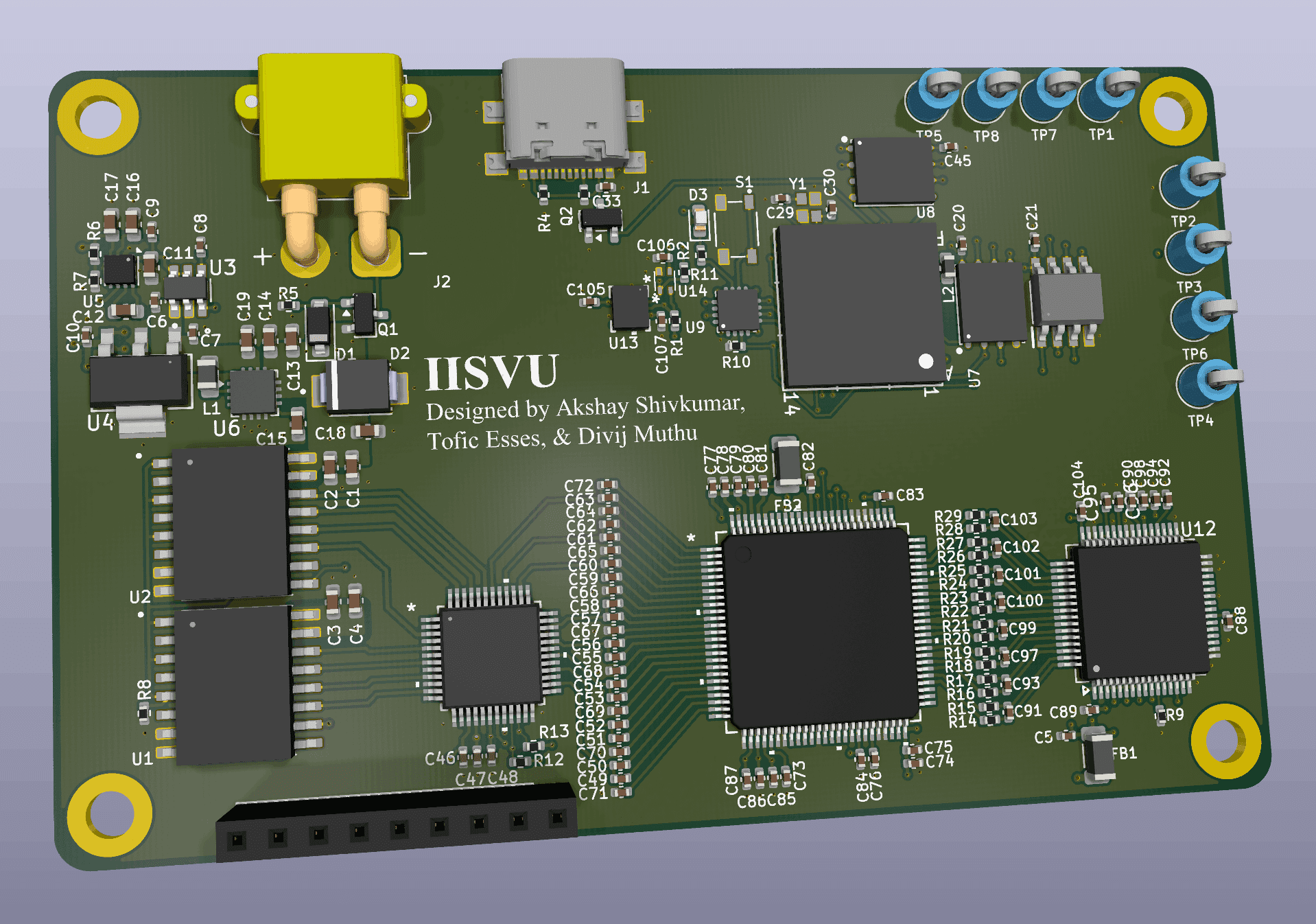
Evolution spent a few million years teaching bats and dolphins to see with their ears. They click, listen to the bounce, and assemble a picture of a world that cameras would just call dark. Robots, somehow, mostly skipped that lesson: we give them cameras and lidars and then act surprised when fog, dust, or a wall in the way blinds them. In-air ultrasound already does the distance part really well. The catch is 3D imaging, which usually means packing dozens of transducers into a dense array that costs more than the optical systems it's supposed to beat, and throws away the power advantage that made ultrasound interesting in the first place. Nature didn't put a thousand ears on a bat. It got clever with a few. IISVU is my lab's attempt at that. An eight-channel piezoelectric micromachined ultrasonic transducer (PMUT) platform reconstructs 3D scenes from a sparse array using compressed sensing. A microcontroller generates eight independent pulse trains and drives lithium-niobate PMUTs independently at 15 V, with carriers from 41 to 58 kHz and delays up to 200 μs. Between transmit and receive, a programmable HV2707 switch matrix routes each element under firmware control. On the receive side, an eight-channel analog front end amplifies echoes by 54 dB into an 18-bit ADC that samples all channels simultaneously at 468.8 kSa/s. A full scene is 100 coded acquisitions; we change each element's frequency and firing delay between shots so every ping hits the scene with a different wavefront, and a sparsity-promoting solver stitches it back together. The same firmware-reconfigurable hardware does two imaging modes with no board changes. For the first, we hid trihedral corner reflectors behind an occluder at 1.14 m and 1.42 m and still localized them to within −0.4 and +0.9 mm, about a tenth of the 6.1 mm transmitted wavelength. For the second, we rotated the array through 24 poses spanning 48° to form a 0.67 m synthetic aperture, which improved lateral resolution 11.3x, from 3.24 cm to 2.87 mm, below half a wavelength. That's the resolution dense arrays usually buy with an order of magnitude more channels. The precision is now limited by the electronics rather than how many transducers we could afford to pack in. Partners: Nikita L., Divij M., Ziv B., Tofic E. Org: Liwei Lin Lab