Tunable EMG Analog Frontend
April 2025
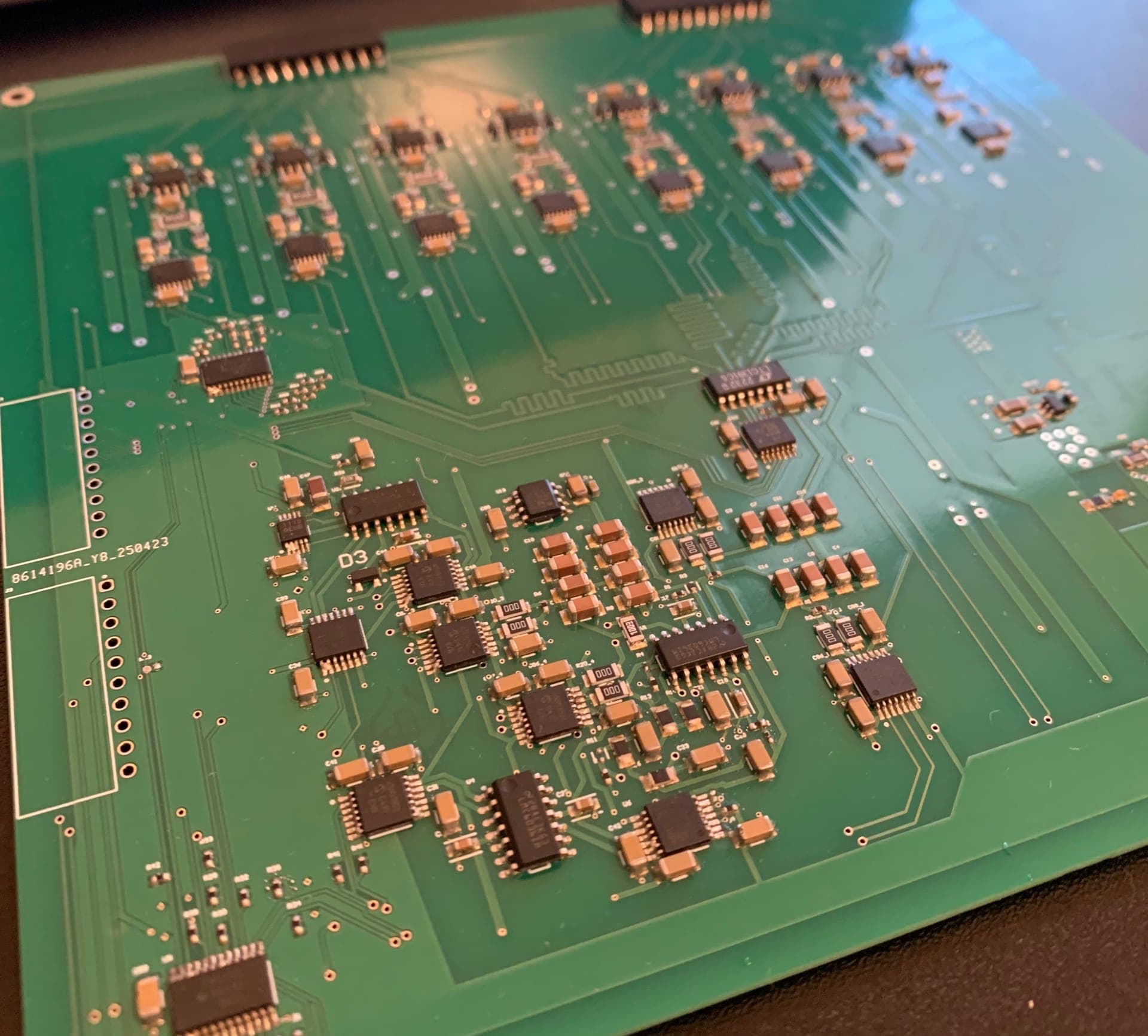
EMG signals vary wildly across muscle groups, electrode contact quality, and individual physiology. A fixed-gain analog frontend either clips on strong contractions or loses resolution on weak ones, which is why most off-the-shelf systems force you to pick a use case and commit. FlexEMG sidesteps that by making the analog chain itself reconfigurable. The 8-channel frontend uses digital potentiometers and rheostats to retune amplifier gain and filter cutoffs in real time, letting the same hardware adapt across muscle groups and electrode conditions without recompiling firmware. Low-noise instrumentation amplifiers feed a 16-bit SAR ADC through an input multiplexer, keeping current consumption low across all eight channels. A PID-based automatic gain control loop tracks the signal envelope and adjusts the digital pots to hold EMG bursts inside the ADC's full-scale range, maximizing usable resolution without clipping. The resulting clean signal stream drove a 4-DOF robotic arm as the first deployment. FlexEMG is the analog backbone of the Doctor Octopus Initiative, our long-term effort to physically recreate the neurally-controlled limbs from Spiderman. The prototype took 1st Place at the 2025 California Neurotech BCI Competition. More to come. Partners: Sean I., Reuben T., Wei W., Aditya A.